What is a liposome
A liposome is a spherical structure made of one or more phospholipid bilayers around a watery core. This is how review papers on liposome technology describe it (Akbarzadeh et al., 2013; Nsairat et al., 2022).
A phospholipid molecule has one part that attracts water and one part that repels it. In water, the molecules arrange themselves into a bilayer, which closes into a sphere. As a result:
- water-soluble substances (for example vitamin C) can sit in the watery core,
- fat-soluble substances (for example vitamin D3) can sit in the bilayer itself,
- liposomes differ in size and number of layers: small single-layer, large single-layer and multi-layer.
Not all of the substance in a product has to be enclosed in liposomes. The share depends on the formula and the manufacturing process. Liposomes are used as a technology both in pharmaceuticals and in foods (Nsairat et al., 2022; Mankan et al., 2025).
What the liposome shell is made of
In food supplements, the liposome shell is made of phospholipids, which mainly come from lecithin. Lecithin is a mixture of phospholipids (mostly phosphatidylcholine) and other lipids. In the food industry it is made from soya, sunflower, eggs or rapeseed (Mankan et al., 2025).
The source of the lecithin matters for your brand. Soya is an allergen listed in Annex II of Regulation (EU) No 1169/2011, so soya lecithin must be emphasised in the list of ingredients. All FluidLabs liposomal formulas use sunflower lecithin.
What a liquid liposomal supplement typically contains
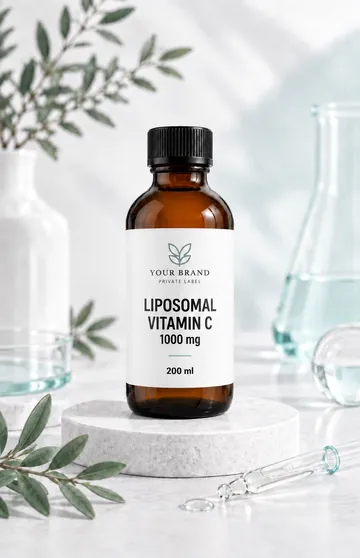
A liquid liposomal supplement consists mostly of water, with glycerol, the active substance and lecithin. The other ingredients provide stability, texture and taste. The example below is the composition of Liposomal Vitamin C 1000 mg from our catalogue (200 ml bottle, daily dose 10 ml, 1000 mg of vitamin C):
| Ingredient (in label order) | Role in the product |
|---|---|
| demineralised water | water phase |
| vegetable glycerol | texture and taste |
| L-ascorbic acid (vitamin C) | active substance |
| emulsifier: sunflower lecithin | source of phospholipids for the liposome shell |
| antioxidant: sodium L-ascorbate | protection against oxidation |
| sea buckthorn extract | taste |
| acidity regulator: sodium bicarbonate | adjusts acidity |
| flavouring | taste |
| thickener: xanthan gum | thickness, less settling |
| preservative: potassium sorbate | microbiological stability of a water-based product |
Ingredients are listed in descending order of weight (Article 18 of Regulation (EU) No 1169/2011). Additives are given with the name of their category, for example ‘preservative: potassium sorbate’. Most of our other liposomal formulas use citric acid as the acidity regulator. The full composition of every product is listed under liposomal supplements.
How a liposomal supplement is made
Phospholipids are dispersed in a water phase containing the active substance, and the mixture is processed mechanically until liposomes of the required size form. Reviews describe these general steps (Akbarzadeh et al., 2013; Mankan et al., 2025):
- Preparing the phases. Lecithin is hydrated in water. The active substance goes into the water or the fat phase, depending on what it dissolves in.
- Forming liposomes. High-shear mixing, ultrasound or high-pressure homogenisation reduce the spheres to a smaller, more uniform size.
- Finishing the formula. A preservative, acidity regulator, thickener and flavouring are added.
- Filling and checks. The product is filled into bottles and closed, and the lot number and best-before date are applied.
Some laboratory methods use organic solvents, so processes without them are preferred for foods. The exact parameters (lecithin ratio, pressure, temperature, order of steps) are the manufacturer’s know-how. They affect both the stability and the taste of the product.
Liquid or capsules
A liposomal supplement can be a liquid or capsules. The forms differ mainly in storage, dosing and taste. The examples in the table come from the FluidLabs catalogue:
| Liquid | Capsules | |
|---|---|---|
| Content | liposomes dispersed in water | a dry blend, for example lecithin, glycerol and maltodextrin as a carrier |
| Dosing | measured volume, for example 10 ml a day | number of capsules, for example 2 a day |
| After opening | in the fridge, use within the period on the label | in a dry place, as on the label |
| Preservative | yes, it is a water-based product | not in our example |
| Taste | needs fine-tuning with flavouring | the capsule is swallowed, taste does not matter |
| Example in the catalogue | 54 formulas in 200 ml bottles | Liposomal Vitamin C 500 mg, 70 capsules |
You’ll find the liquid formulas under liposomal supplements and the capsules under capsules.
How to store liposomal supplements
Storage and shelf life follow the label. The manufacturer sets the minimum durability, the storage conditions and the period of use after opening.
The reason is the stability of liposomes. Phospholipids are prone to oxidation and hydrolysis. Liposomes can clump, merge and release their contents, and higher temperatures and an unsuitable pH speed this up (Akbarzadeh et al., 2013; Mankan et al., 2025). Labels of liquid liposomal supplements therefore usually say:
- store away from direct sunlight within the temperature range on the label,
- do not freeze,
- shake before use,
- after opening, keep in the fridge and use within the stated period.
For your brand, this means three practical things. Protect the goods from frost and heat in storage and in transport. Order only as many units as you can sell within the shelf life. Repeat the after-opening instructions in the product description in your online shop.
How (not) to talk about liposomal products
Describe the form and the composition, not the effect. Claims about better absorption or ‘bioavailability’ are risky both in advertising and on the label.
- Regulation (EC) No 1924/2006: a claim must not be false, ambiguous or misleading (Art. 3) and must be substantiated by generally accepted scientific evidence (Art. 6). Health claims are prohibited unless they are authorised (Art. 10(1)) (EUR-Lex). This also applies to communication aimed only at health professionals (Case C-19/15).
- Misleading information: food information must not mislead or attribute properties to a food that it does not have (Art. 7 of Regulation (EU) No 1169/2011). Misleading commercial practices are also banned by Directive 2005/29/EC.
- On the label you may use only authorised health claims from the EU Register (Regulation (EU) No 432/2012), and only when the conditions of use are met. A claim relates to a nutrient or substance (for example vitamin C), not to the liposomal form.
- Evidence differs by substance and cannot be transferred from one substance, or one product, to another. A systematic review of vitamin C forms found three studies on the liposomal form and concluded that more robust evidence is needed to confirm benefits (Calder et al., 2025).
| Risky | More factual |
|---|---|
| ‘Up to 10× better absorption’ | ‘Vitamin C in liposomal form based on sunflower lecithin’ |
| ‘Maximum bioavailability’ | ‘1000 mg of vitamin C in a 10 ml daily dose’ |
| ‘More effective than tablets’ | ‘A liquid form for customers who prefer not to swallow tablets’ |
| ‘Liposomes deliver the substance straight into cells’ | ‘A liposome is a sphere with a shell of phospholipids’ |
| ‘Boosts immunity’ | the exact wording of an authorised claim for the nutrient from the EU Register, if the product meets the conditions |
If you still want to claim something about the properties of the form, you need studies on that substance and form, ideally on your own product, and a legal review. The rules are explained in our guide Health claims on food supplements. We do not make absorption claims for our products.
What to check when choosing a supplier
When choosing a supplier of liposomal supplements, check the production, the composition, the stability and what the supplier recommends you put on the label.
- Origin and traceability. Where the product is made and whether every lot can be traced.
- Full composition. The lecithin source, additives with their categories, the amount of active substance per daily dose and the % of the nutrient reference value (NRV).
- Shelf life and storage. Minimum durability, the period after opening and temperature conditions.
- Stability in practice. Check a sample for appearance, settling and taste.
- Claims. The business under whose name the product is marketed is responsible for the label information (Article 8 of Regulation (EU) No 1169/2011). A supplier’s promises about absorption therefore pass the risk on to you.
- Notification in your country. In most EU countries, a food supplement must be notified to the competent national authority before it is placed on the market. Check whether the supplier will help; see Food supplement notification in the EU.
- Label documents. Label texts in the languages of your markets and a check of the artwork; see Food supplement label requirements.
- Minimum order, prices and lead times. The minimum per product, price tiers and delivery time.
How we can help
FluidLabs supplies private label food supplements from 25 units per product. Our 54 ready-made liposomal formulas come in 200 ml bottles, are based on sunflower lecithin and are made in our own production in Slovakia. We deliver them with your label from 25 units per product, or without a label if you prefer to apply your own; label texts are available in selected languages. Prices are public in the price list. For a liposomal formula of your own, see contract manufacturing (roughly from 100 litres) or send us an enquiry.
Frequently asked questions
What does liposomal mean?
Liposomal means that the active substance is enclosed in liposomes – spheres with a shell of phospholipids, which in foods usually come from lecithin. The word describes the technological form of the product, not its effect.
What is the liposome shell made of?
Phospholipids. In the food industry they mainly come from lecithin made from soya, sunflower, eggs or rapeseed. Soya is an allergen, so soya lecithin must be emphasised in the list of ingredients. FluidLabs liposomal formulas use sunflower lecithin.
Is a liposomal supplement always liquid?
No. The liquid form in a bottle is the most common, but there are also capsules with a dry liposomal blend. The FluidLabs catalogue has 54 liquid liposomal formulas in 200 ml bottles and a liposomal vitamin C in capsules.
How long does a liposomal supplement keep after opening?
As stated on the label. The manufacturer sets the minimum durability, the period of use after opening and the storage conditions. Liquid liposomal supplements are usually kept in the fridge after opening and must not freeze.
Can I say on the label that the liposomal form is better absorbed?
We advise against it. Every claim must be truthful, not misleading and substantiated by generally accepted scientific evidence (Regulation (EC) No 1924/2006), and the evidence differs from substance to substance. The label should carry authorised health claims for nutrients from the EU Register. Have any specific wording reviewed by a food law specialist.
What is the minimum order for a liposomal supplement under my own brand?
For FluidLabs ready-made formulas, 25 units per product; products can be combined. A liposomal formula of your own starts at roughly 100 litres.
Sources
- Akbarzadeh et al. (2013): Liposome: classification, preparation, and applications
- Nsairat et al. (2022): Liposomes: structure, composition, types, and clinical applications (Heliyon)
- Mankan et al. (2025): Food-Grade Liposome-Loaded Delivery Systems: Current Trends and Future Perspectives (Foods)
- Calder et al. (2025): Enhanced Vitamin C Delivery – a systematic review of alternative supplement forms (Nutrients)
- Regulation (EC) No 1924/2006 on nutrition and health claims made on foods
- Regulation (EU) No 432/2012 – list of permitted health claims
- EU Register of nutrition and health claims (European Commission)
- Regulation (EU) No 1169/2011 on the provision of food information to consumers
- Directive 2005/29/EC on unfair commercial practices
- Court of Justice of the EU, Case C-19/15 (Innova Vital, 14 July 2016)
This text is general information, not legal advice. Rules change; check the current wording before placing a product on the market.